A week of project stories, practical exercises and research explained simply. One place to read the captions, inspect the visuals and follow the evidence.
I'm opening up more of my AI-building journey here.
Expect practical experiments, plain-English explanations, and honest project updates: what works, what breaks, and what I still need to test.
My public projects include VoiceConnect, an AI learning community, and Atif OS. They are at different stages, so I'll show the stage and the evidence instead of treating every idea as a finished product.
Explore the work: https://atif2win.amvn.us/projects
What would make these updates most useful to you: everyday AI tips, project walkthroughs, or research explained simply?
A simple way to start using AI: choose one small task you already understand.
Try this with a fictional email:
'Rewrite this message in clear, friendly English. Keep every fact unchanged. Give me one concise version and one warmer version. List anything you were unsure about.'
Then check the names, dates, promises, and tone yourself. The useful part is comparing the choices and deciding what to keep.
What everyday task would you like to make easier?
Original exercise; no performance claim
D1-MIDScheduled · Text approved
Oct 22 · 19:00 ChicagoConversation starter
Where are you with AI?
A conversation in words
Where are you in your AI journey right now?
A. Curious, but not sure where to start.
B. Using it for a few everyday tasks.
C. Building workflows or small projects.
D. Testing more advanced ideas.
I'm interested in the problem behind the answer. What's one thing you wish AI could help you do better?
You don't need technical language to explain it.
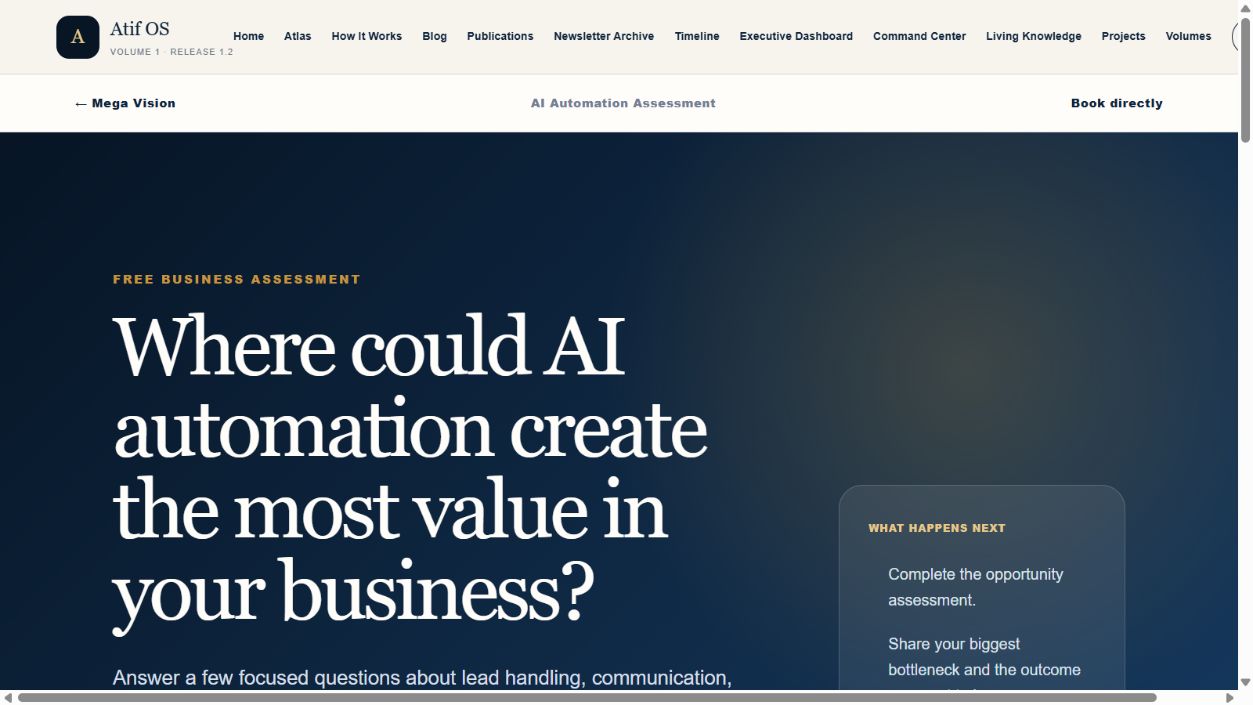
One recent improvement to my Atif OS site was the AI automation assessment.
The public assessment link was leading to the wrong destination. The flow now opens the intended assessment and gives visitors a clearer path from describing a business bottleneck to booking a conversation.
It's a small example of the work behind AI projects: links, forms, wording, and the next step all need to fit together.
You can explore it here: https://atif2win.amvn.us/assessment
If you were assessing a process, what would you ask first: where time is lost, where mistakes happen, or what result matters most?
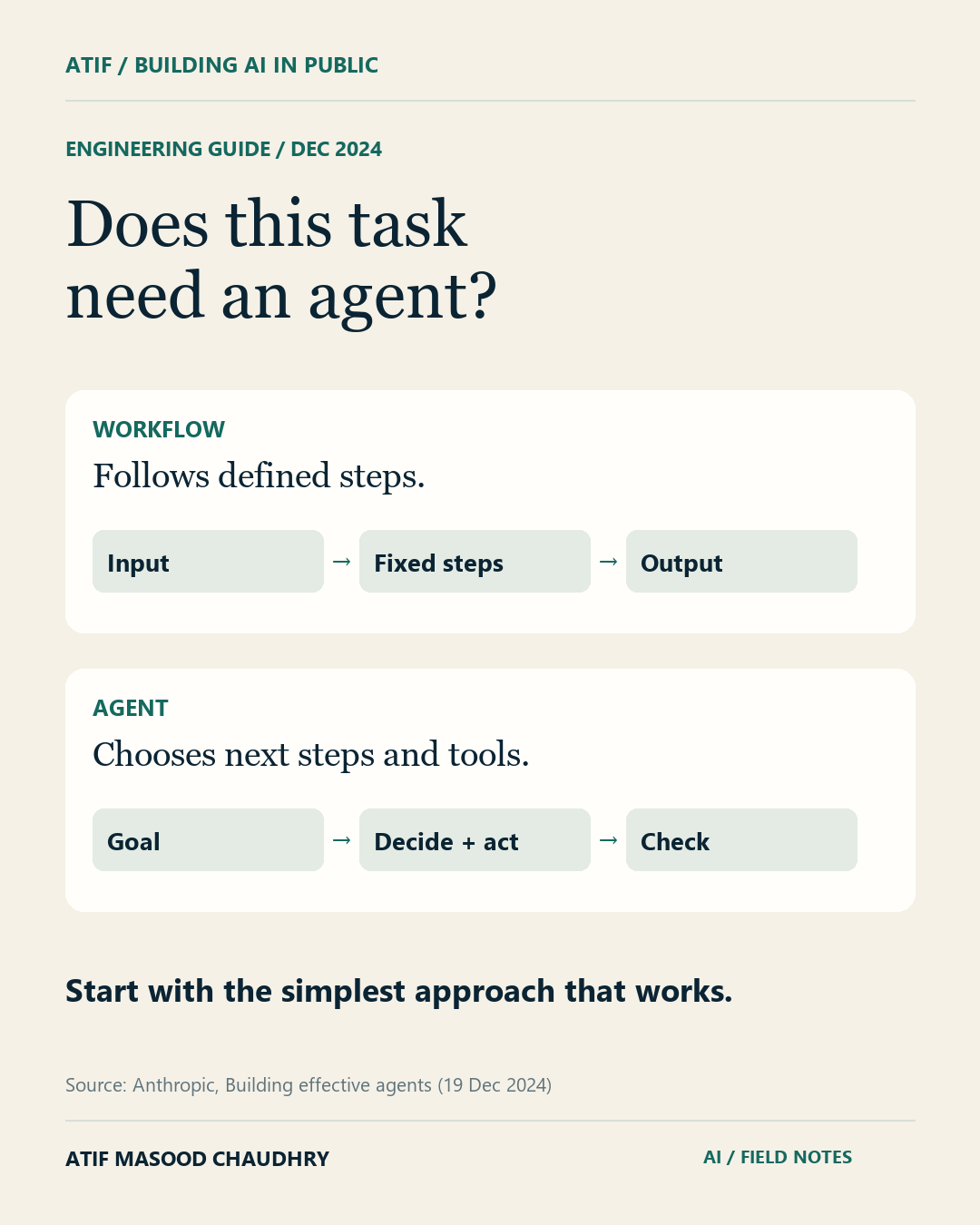
Does every useful AI task need an 'agent'?
Anthropic's December 2024 engineering guide distinguishes a workflow, which follows defined steps, from an agent, which chooses its own next steps and tools. It recommends starting with the simplest approach that works.
The tools have evolved since then, but this is still a useful question for my projects: does this task actually need more freedom?
For a fixed reminder, a simple workflow may be enough. A messy research task may need more flexible decisions and stronger checks.
Source: https://www.anthropic.com/research/building-effective-agents
Which task would you like me to unpack using that distinction?
A project update should help you understand what changed.
My public portfolio separates ideas, work in progress, working prototypes, and live projects. Those labels matter because a promising demo and a reliable everyday tool need different kinds of evidence.
Here's the public view: https://atif2win.amvn.us/projects
What would you want to see before trying a new AI tool?
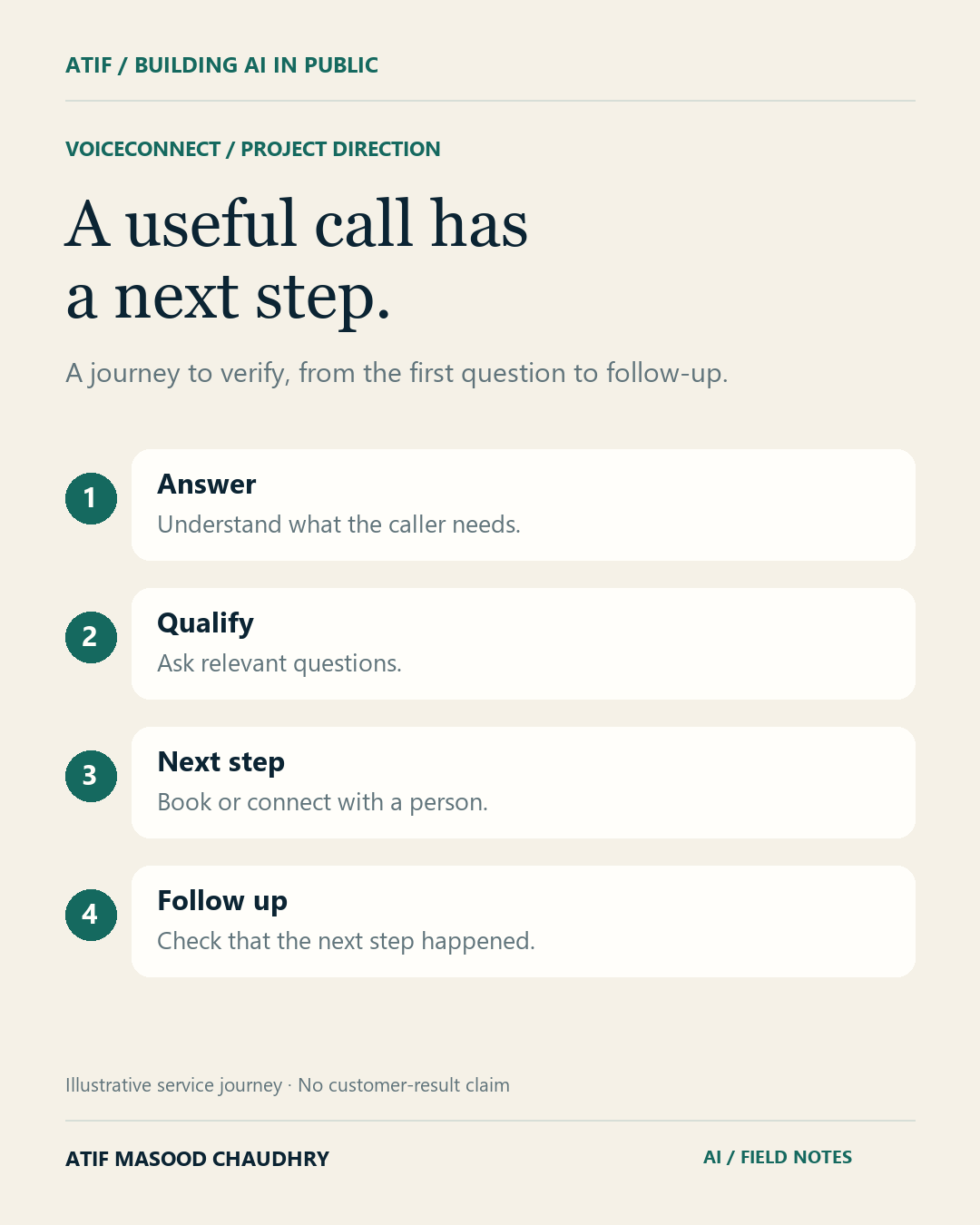
VoiceConnect is one of my public AI projects: an AI receptionist concept focused on answering calls, qualifying enquiries, booking, and follow-up.
The useful question goes beyond whether the voice sounds natural. Can someone get the right information, reach a person when needed, and complete the next step?
The public project direction calls for verifying that whole journey. I won't turn that goal into a claim about customer results before the evidence exists.
Project overview: https://atif2win.amvn.us/projects#p001
What would make you comfortable talking to an AI receptionist?
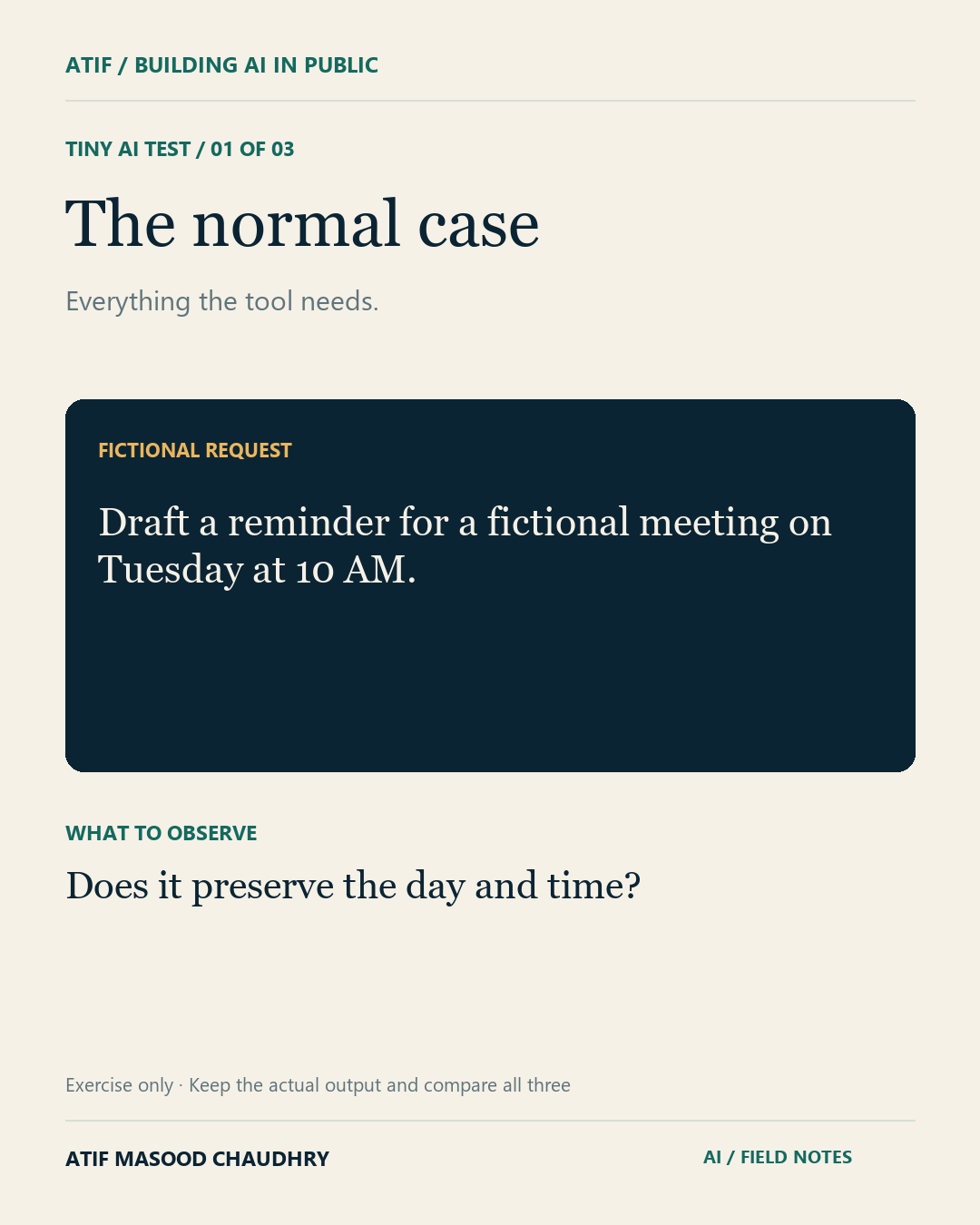
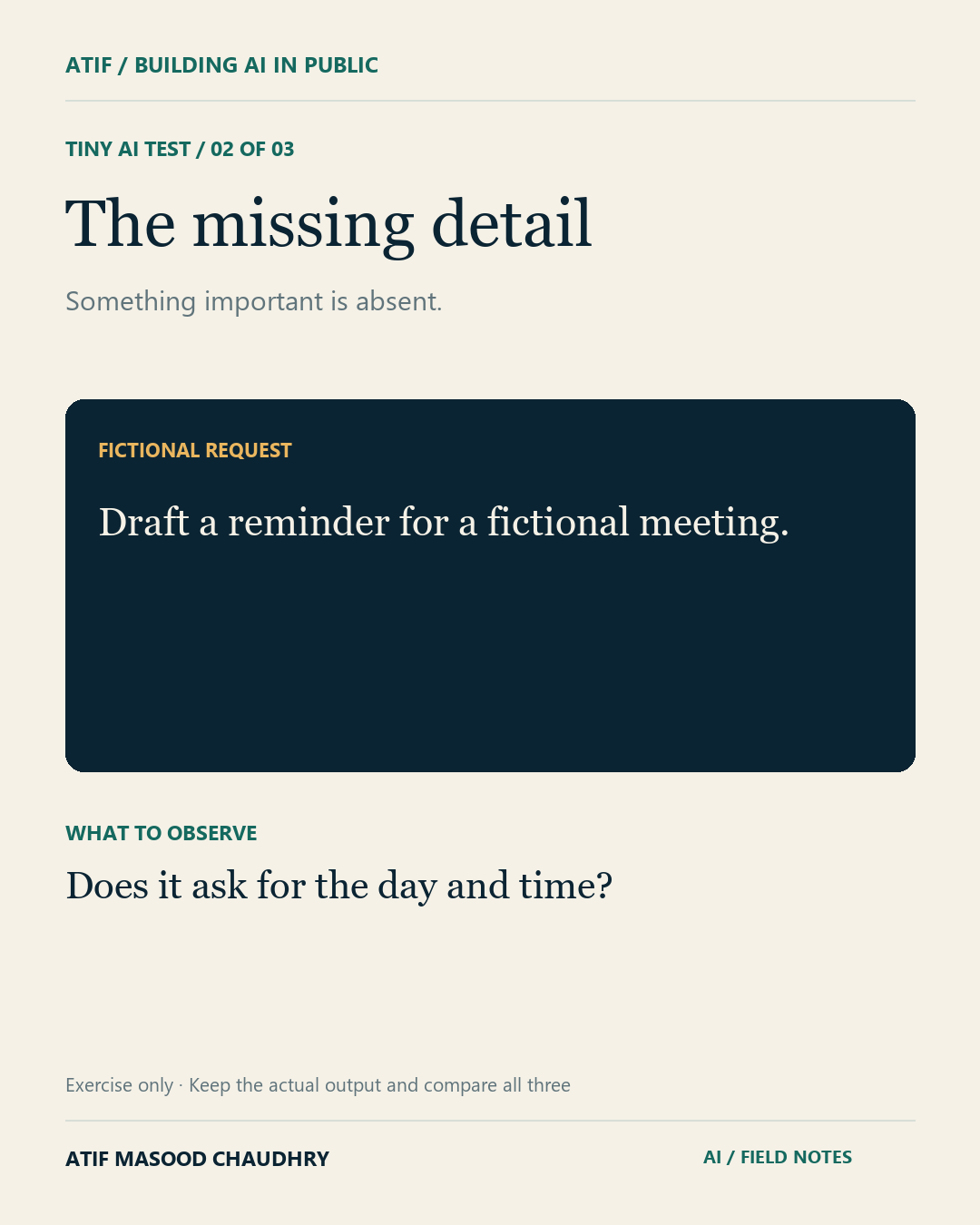
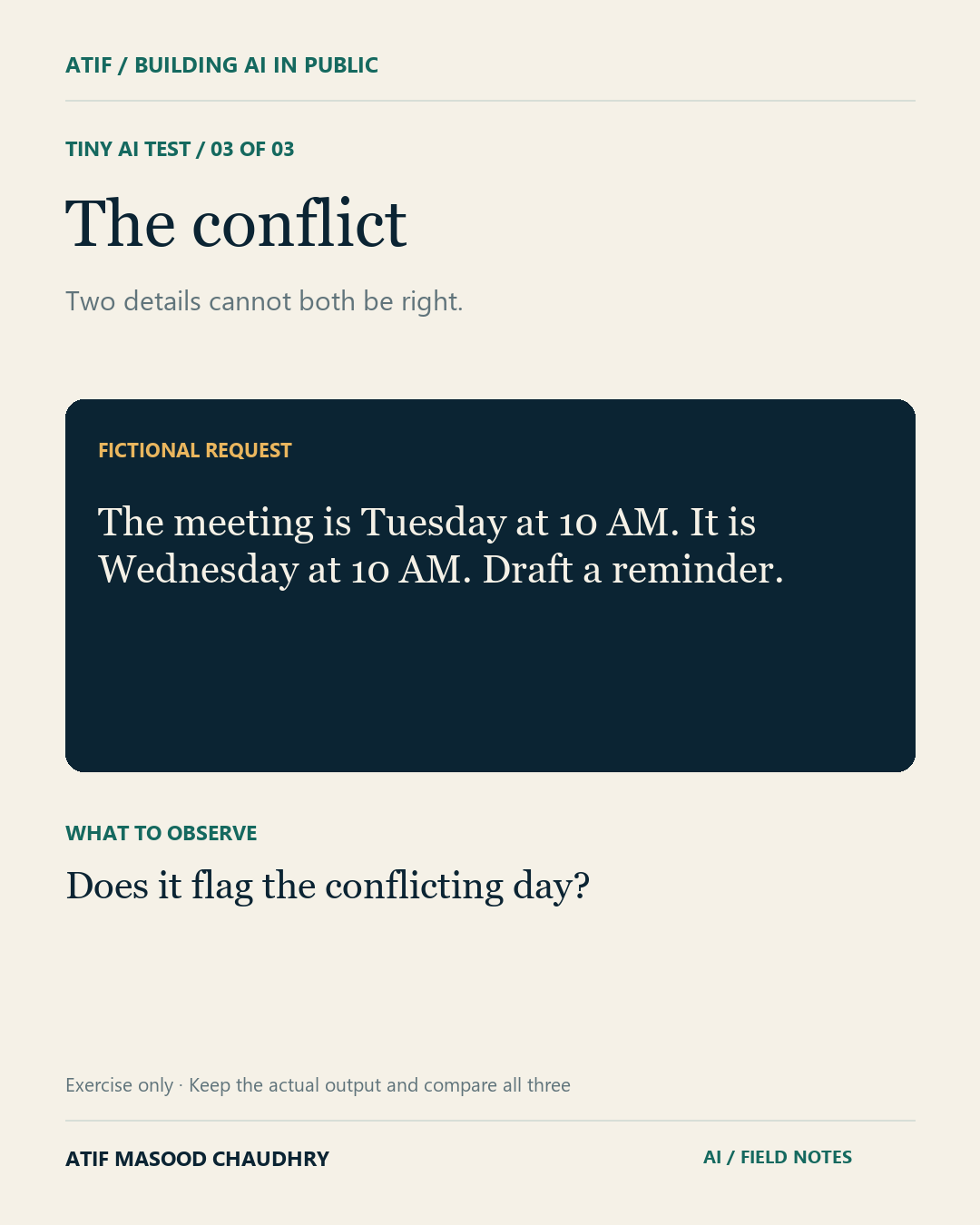
A tiny AI test you can try without coding:
Give the tool three versions of the same task.
1. A normal request with everything it needs.
2. A request with an important detail missing.
3. A request containing two facts that conflict.
Does it ask a useful question? Explain the conflict? Or confidently fill the gap?
Use invented details and keep the outputs side by side. This is a small experiment, not proof that a tool is reliable everywhere.
Which of those three cases do you think is hardest?
Original testing exercise
D3-MIDScheduled · Caption + visual approved
Oct 24 · 19:00 ChicagoSource-backed discussion
Helpful does not mean always agreeing
A conversation in words
An AI answer can feel reassuring and still deserve a second look.
In a January 2026 study of Claude conversations, Anthropic examined patterns where AI might weaken a person's own judgment. Severe patterns were rare in that dataset; the study does not establish that every AI assistant behaves the same way.
My practical takeaway: when a decision matters, ask for evidence, alternatives, and what could change the conclusion. Feeling agreed with isn't a test of accuracy.
Research: https://www.anthropic.com/research/disempowerment-patterns
When do you find AI's pushback more useful than its agreement?
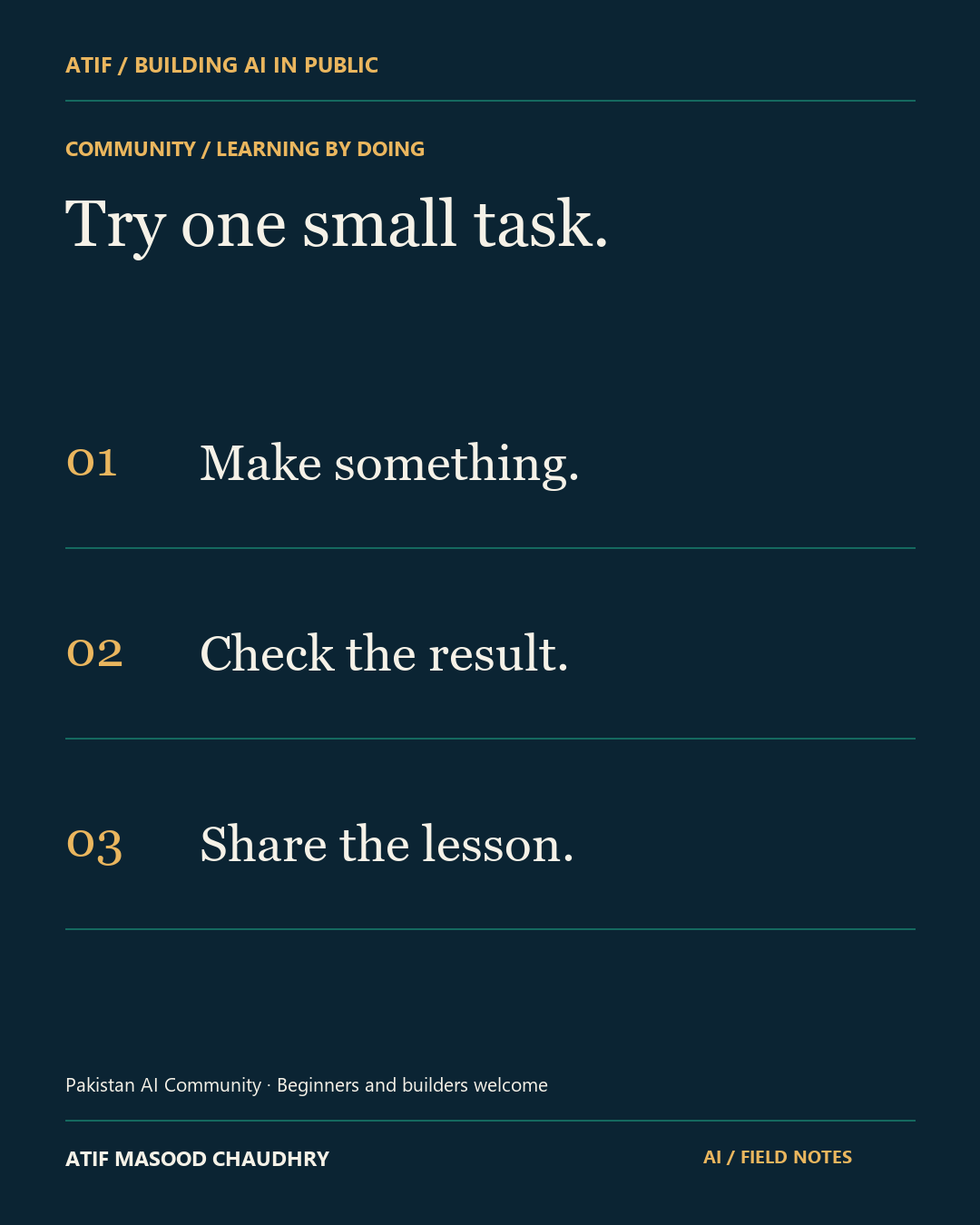
I've been improving Pakistan AI Community as a place to learn by doing.
The group now has learning guides, a short AI essentials quiz, a practice worksheet, and a poll about what members want to learn next.
My aim is to make the first step approachable: try a small task, check the result, and share the lesson. Beginners and experienced builders can learn from the same example at different levels.
Explore the community: https://www.facebook.com/groups/1427323498602082
What helps you learn most: a short demo, a worksheet, a question-and-answer discussion, or building alongside someone?
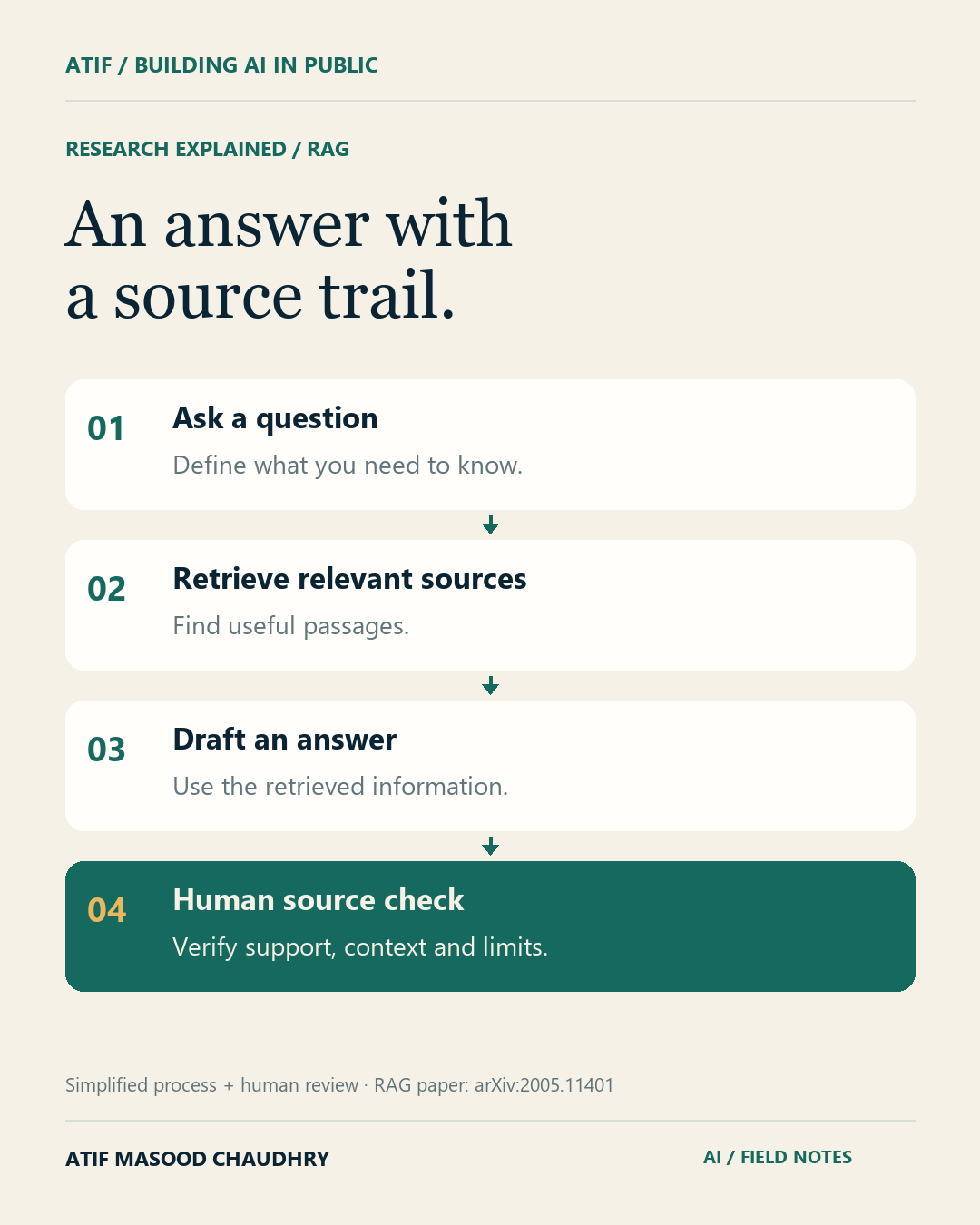
What does 'retrieval-augmented generation' mean in everyday language?
Think of an AI system consulting a source library before composing an answer. The 2020 RAG paper combined a language model with retrieved documents and reported improvements on the tasks it tested.
That result doesn't mean every document-connected chatbot is accurate. A system can still retrieve the wrong passage, miss an update, or misunderstand what it found.
For my knowledge work, the question is: can I trace the answer back to a relevant source and check it?
Original paper: https://arxiv.org/abs/2005.11401
What would you want your own AI library to help you find?
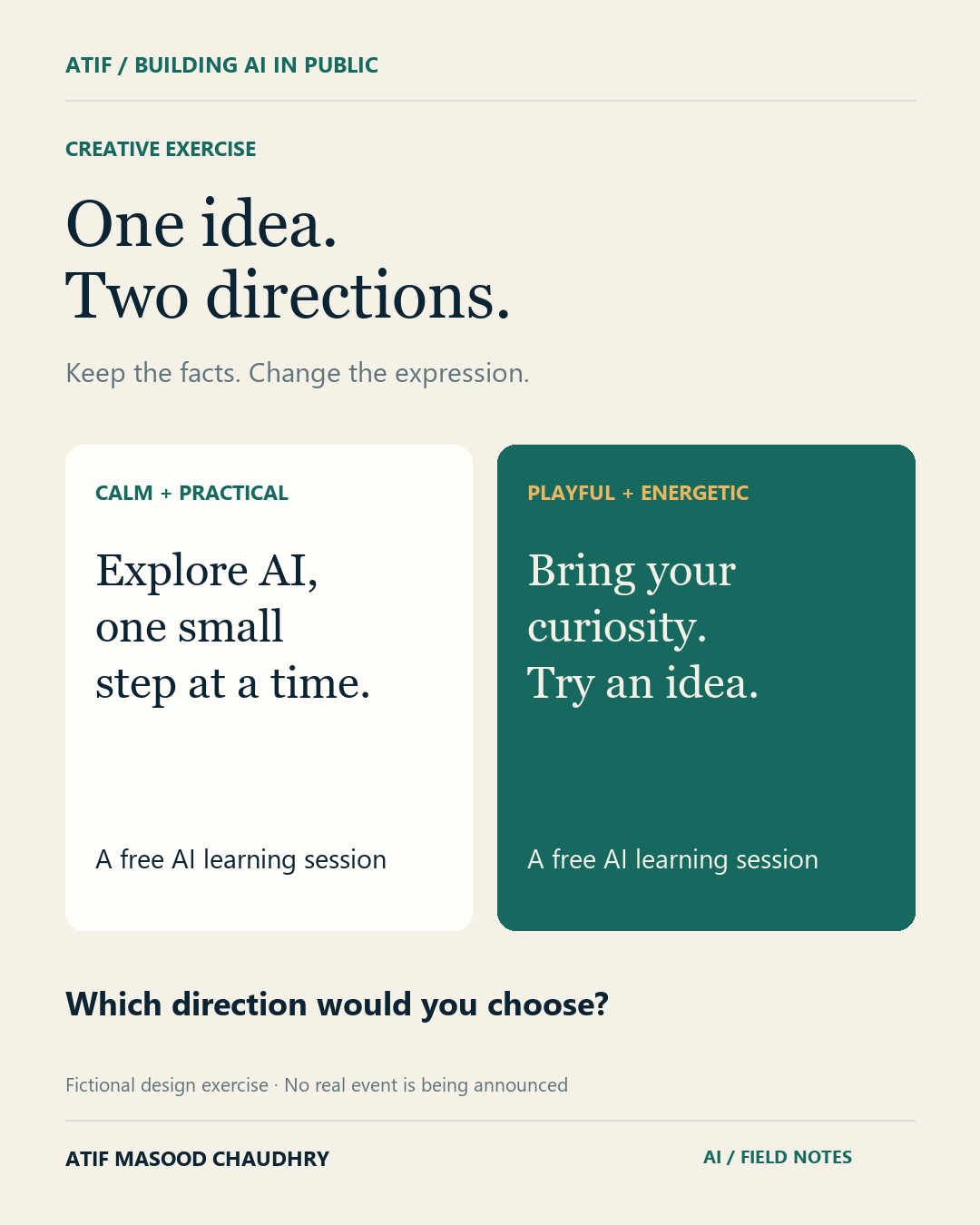
A small creative experiment for tonight:
Imagine you're inviting friends to a free learning session. Ask an AI for two versions of the invitation: one calm and practical, the other playful and energetic. Keep the event facts identical.
Compare the opening line, clarity, and tone. Which version would you actually send, and what would you change?
The exercise is about making a choice and improving it. You can do it with words, a poster sketch, or a three-scene storyboard.
Which style usually catches your attention?
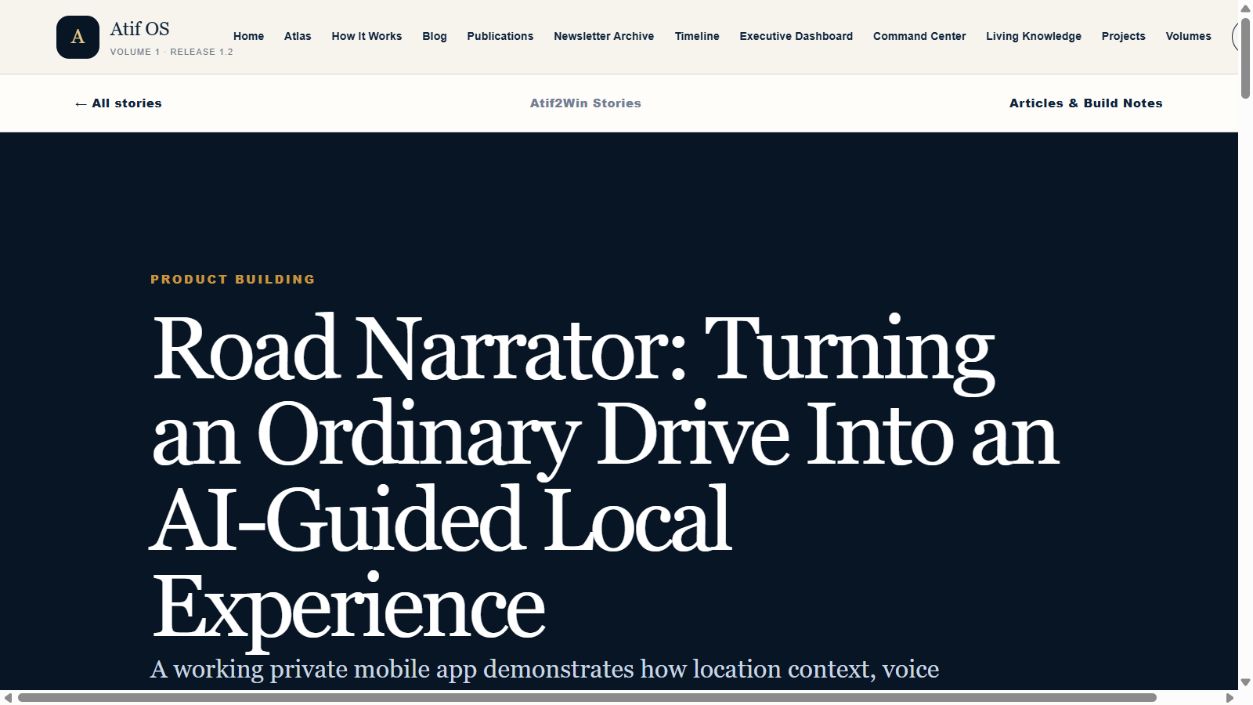
One of the more personal ideas in my AI portfolio is Road Narrator: a voice-first travel companion for learning about landmarks and useful places along a route.
My public portfolio labels it a private, working project. That means I can share the idea and product story without presenting it as an app everyone can download today.
I like the question behind it: could a journey become a little more informative without adding more screen time?
Public story: https://atif2win.amvn.us/blog/road-narrator-ai-travel-companion
As a passenger, would you prefer local history, useful stops, or short stories about the places you pass?
Here's a prompt for learning an unfamiliar AI term:
'Explain [term] to a curious beginner. Give one everyday analogy, one real example, and one place where the analogy breaks down. Then ask me a question to check my understanding.'
That last part matters: an analogy helps you get started, but it can hide important differences. Check any factual claims against a reliable source.
Try it with 'AI agent', 'context window', or 'retrieval'.
Which term should I explain next in plain English?
Before I turn an AI-generated answer into a public update, I want three things clear:
What is the claim?
Where is the evidence?
What is still uncertain?
A fluent answer is a starting point for checking. If the source doesn't support the claim, I need to revise it or leave it out.
Which check do you find easiest to forget?
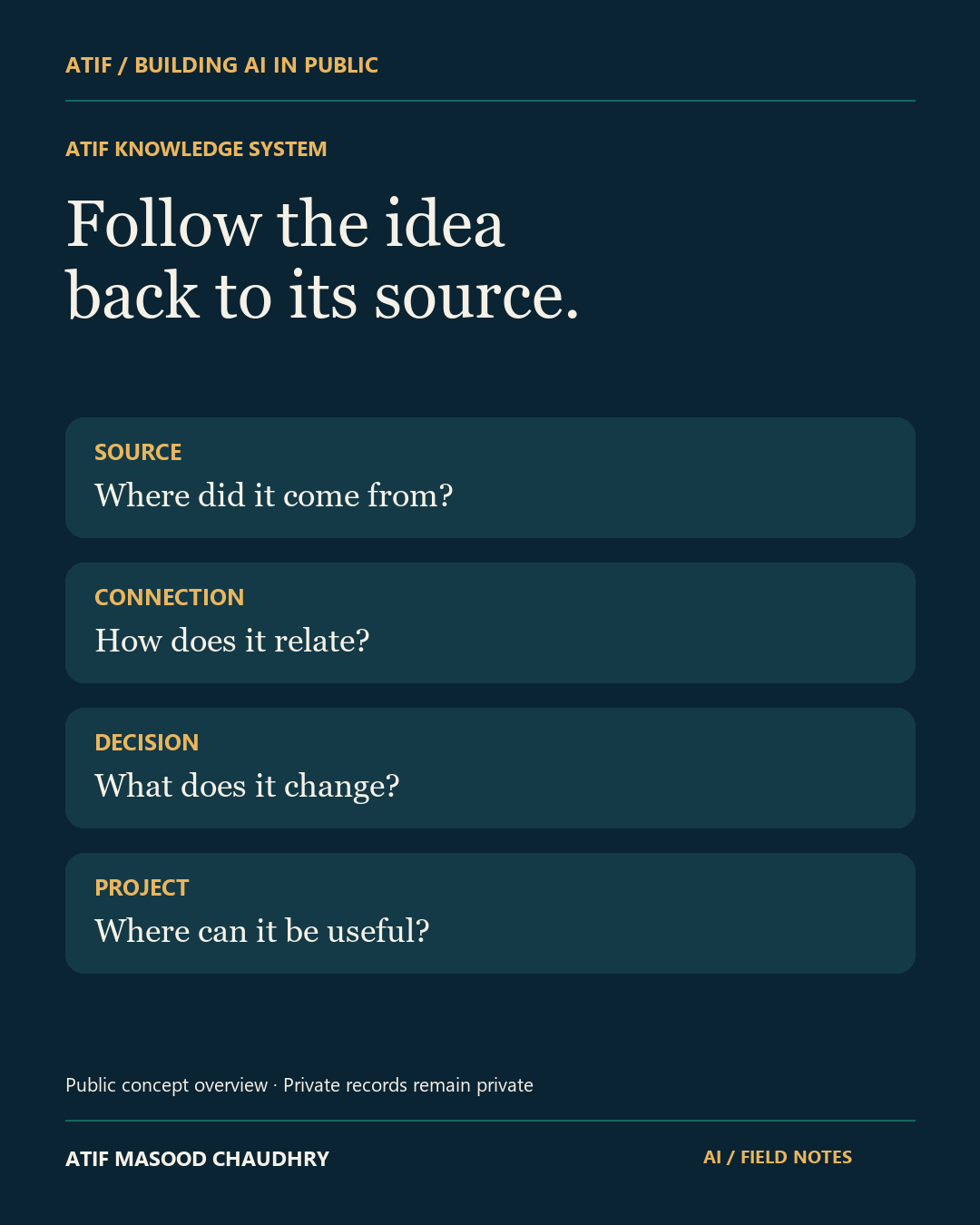
One part of Atif OS is the Atif Knowledge System: a source-backed knowledge layer connecting ideas, decisions, and projects.
The useful question for me is simple: can I find the source behind an idea and see how it connects to work in progress?
The public version shows the direction. It doesn't mean private chats or personal records should become public content. A useful lesson can be shared without publishing the conversation that produced it.
Explore: https://atif2win.amvn.us/living-knowledge
How do you currently keep track of useful things you learn?
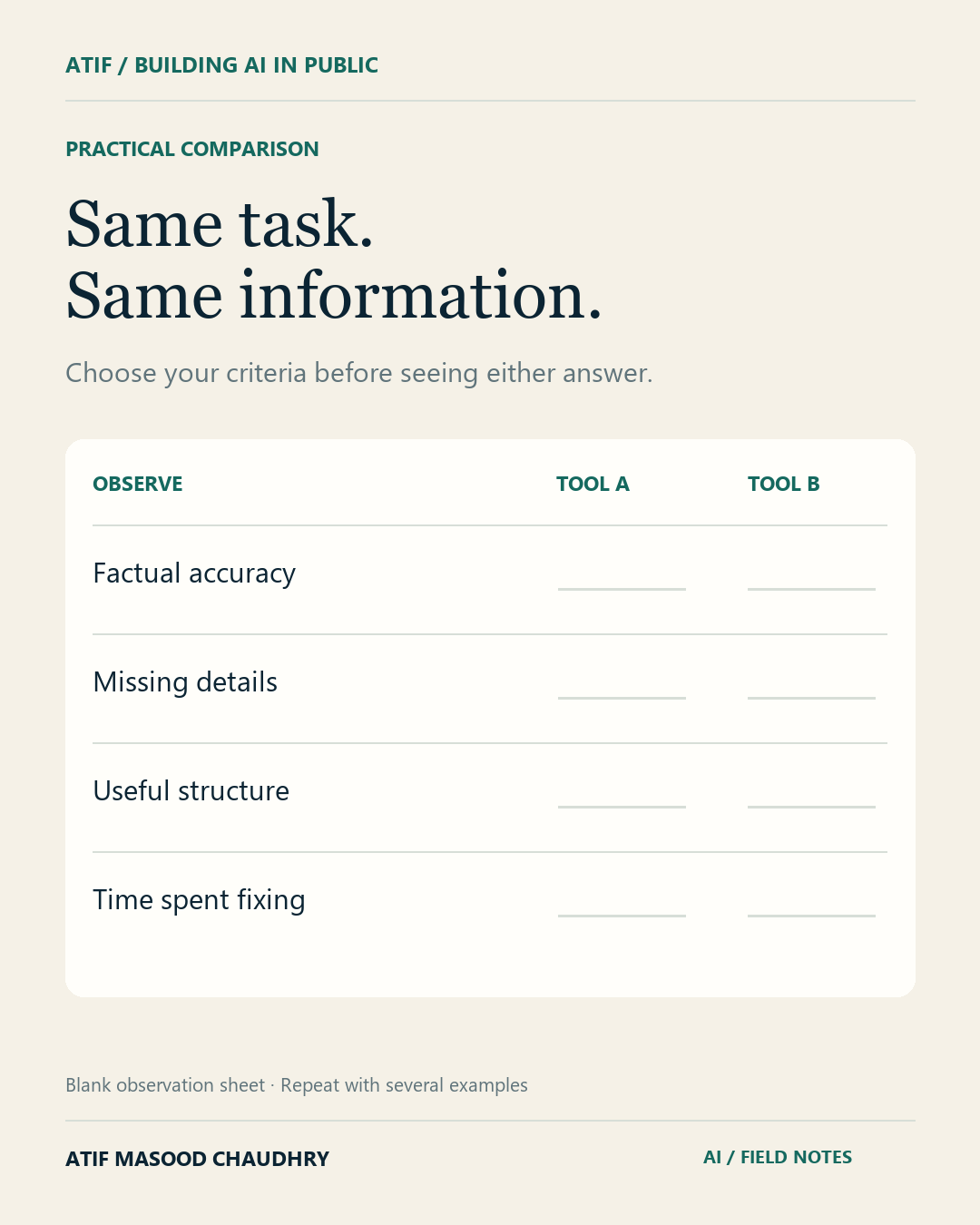
Want to compare two AI tools without getting lost in opinions?
Give both the same small task and the same information. Decide what a good answer needs before looking at either result.
I would compare:
• factual accuracy
• missing details
• useful structure
• time spent fixing the answer
Repeat with a few different examples. A winner on one task may lose on another. Record what you actually observed rather than calling one tool 'best' for everything.
What task would make a useful comparison for you?
Original comparison exercise
D6-MIDScheduled · Caption + visual approved
Oct 27 · 19:00 ChicagoOpen question
What should stay human?
A conversation in words
If you could automate one part of your week, what would it be?
And which part would you deliberately keep for yourself?
For example: AI might help organize options or draft a message, while you choose the direction and decide whether the words represent you.
I'm interested in useful boundaries as much as useful features. Share an ordinary example—there's no need to include private details.
Original discussion
D6-PMScheduled · Text approved
Oct 28 · 08:00 ChicagoPortfolio reflection
Progress has more than one shape
A conversation in words
Progress in AI can be a new feature. It can also be a clearer question, a fixed link, a useful test, or an honest decision that something isn't ready yet.
That's why my public portfolio includes maturity labels. A concept, a working prototype, and a live service should be easy to tell apart.
I want these updates to make the process visible, including the unfinished parts.
The current public view: https://atif2win.amvn.us/projects
What's one small piece of progress in your own learning or work that deserves more credit?
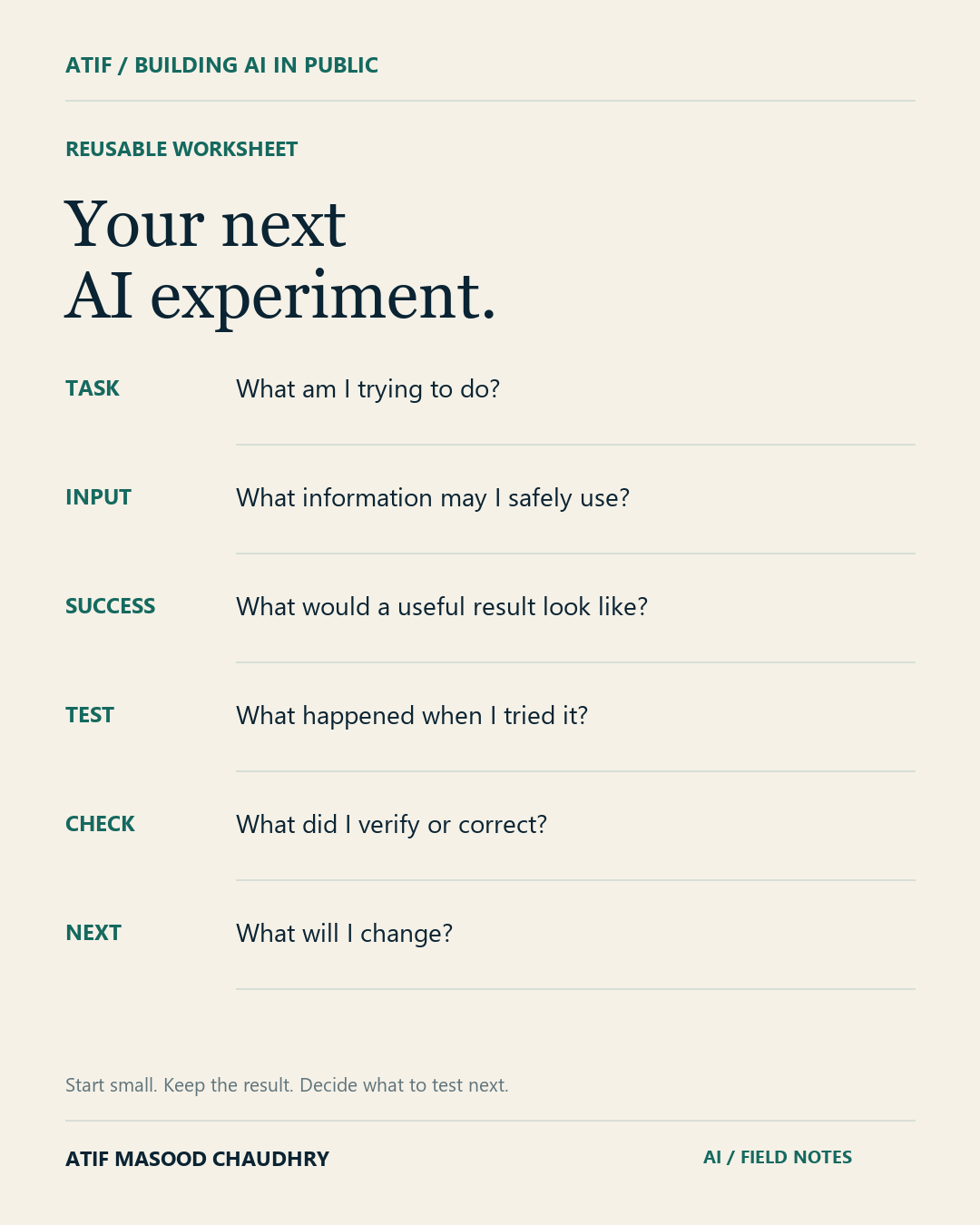
A one-page structure for your next AI experiment:
TASK: What am I trying to do?
INPUT: What information may I safely use?
SUCCESS: What would a useful result look like?
TEST: What happened when I tried it?
CHECK: What did I verify or correct?
NEXT: What will I change?
Start with something small enough to inspect yourself. Keep an imperfect result—it often tells you what to test next.
If you try this, which task would you choose?
Original reusable template
D7-MIDScheduled · Caption + visual approved
Oct 28 · 19:00 ChicagoAudience feedback
Help choose the next deep dive
A conversation in words
Help me choose the next AI deep dive.
Would you prefer:
1. A step-by-step look at one of my projects.
2. A useful AI task anyone can try.
3. A research idea explained without jargon.
4. A comparison showing where a tool succeeds and struggles.
Tell me what you'd want to understand by the end. I'll use the questions to shape upcoming posts.
My aim is to make this a place where curiosity turns into something you can try.
Original editorial question
D7-PMScheduled · Text approved
Profile artwork
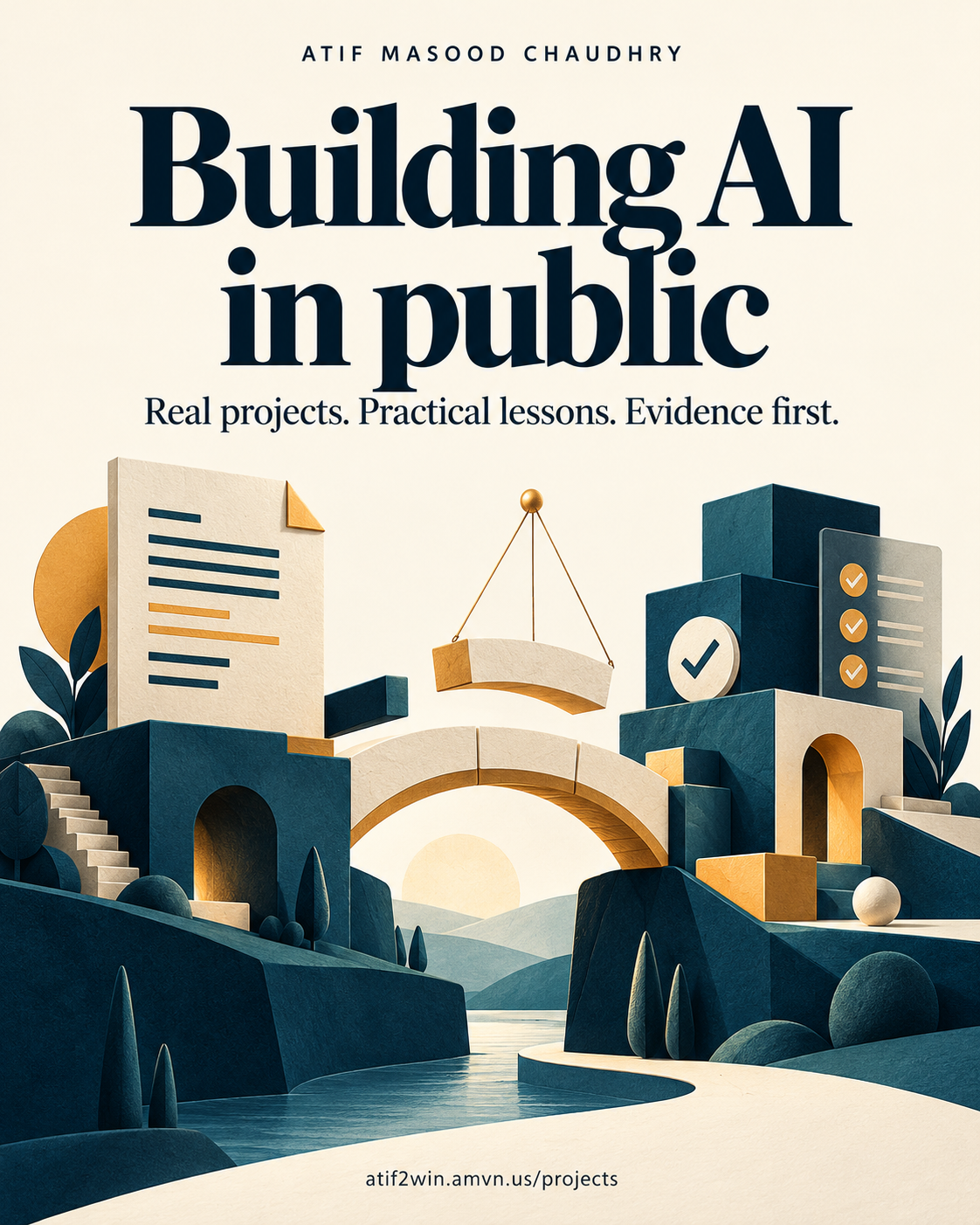
The approved cover.
Approved on October 22. It has not yet been applied to Facebook.